Recently, we have been seeing an increase in the number of “green buildings” by environment-conscious architects. But sustainability in architecture and design is not a new concept. The One Angel Square in Manchester, ParkRoyal in Singapore, and Jawaharlal Nehru Bhavan in New Delhi are some old examples of sustainable architecture.

Our ancestors ensured that even abundantly available resources were used without wastage so that the future generations would not suffer. So, in typically sustainable historic structures, indigenous materials were used to keep their habitats cool or warm, depending on the climatic zone. They also made highly complex water and sewage systems without using PVC for pipes

Looking at ancient sustainable architecture, Ajanta Caves, situated in Aurangabad (Maharashtra), comes to our mind. This structure consists 29 rock-cut Buddhist Chaityas and Viharas. A good example of sustainable design within the caves is the vaulted ceilings of the Chaityas which brings in a lot of sun to illuminate the prayer hall. While most caves have a high ceiling, Ajanta caves have low ceilings to implement the tunnel effect horizontally. The low ceilings let hot airflow into the cells around the prayer hall on either end, which were filled with cool water. This way, the water-cooled air cools down the whole cave. Additionally, the cave stone also adds to the cooling effect.
Ait Ben Haddou in Morocco and Granada Alhambra in Spain are two other ancient villages made completely with pounded earth. Even at present, this technique is a favorite among architects in making green and sustainable structures.

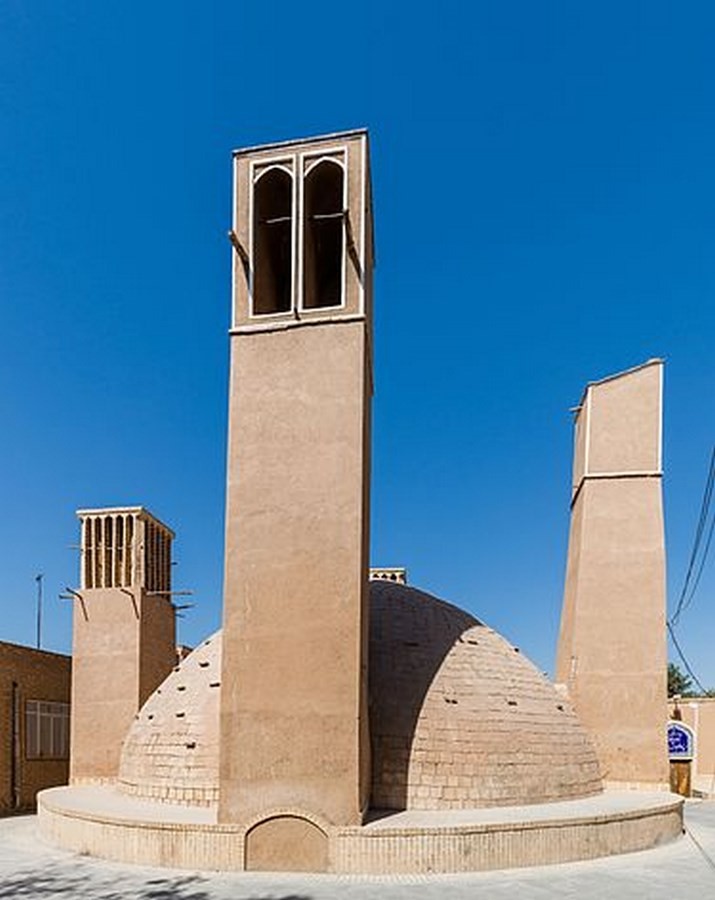
Further, the Persian Wind towers, also known as Badgirs, are another kind of device widely used in ancient architecture to maintain cool temperatures inside buildings. The wind tower openings catch the air above the ground and send it to the low-situated living spaces, which end up getting cool air. This creates a pressure gradient, directing the hot air upwards and out through the openings. Similarly, these towers were also made use of in arid regions’ water reservoirs where water would be stored at nearly frigid temperatures during summer months, owing to cooling due to evaporation. Notably, such wind towers can also be found in Iran and Bahrain and are commonly used in the Middle East and even Rajasthan, India, even today.